Rear hook
Mechanics / Hands / Shadow
The lead hook with the sides swapped: rear side loads, rear heel turns, fist arcs across at chin height.
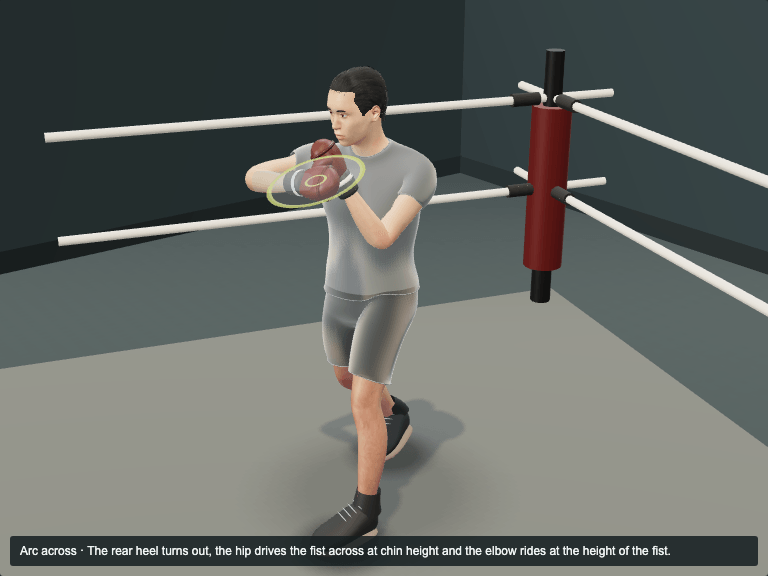
Elbow level with the fist
- Load the rear side by winding the hips, not by pulling the hand back.
- The rear heel turns out as the fist arcs across.
- Elbow level with the fist all the way round.
Mechanics / Build / Shadow
Why it matters
Most boxers throw the rear hook badly because they learn it after the lead hook and assume it is the same thing. The sides swap, and the rear heel has to do what the lead heel did.
Walk through it
- GuardRear hand on the jaw, rear heel light
- Load the rear sideThe hips wind back a touch; the hand stays
- Arc acrossHeel out, hip drives, fist across at chin height, thumb up
- RecoverTurn back the way you came, hand on the jaw before the feet are square
Common faults
- Elbow dropsLevel with the fist, or it is a slap
- Hand winds upThe load is the hips; if the glove leaves the jaw to load, it is a wind up
- Lead hand opensWatch the lead glove through the turn; it stays on the cheek
Drill
3 rounds of 2 min, 45 s rest. 8 slow rear hooks a round, then 4 lead hooks to feel the difference
Solo study: no partner, no contact, not verified by a coach. Rehearse a movement your coach has already shown you.
The movements inside it
- Boxing guard: Set the feet, Hands home, Check balance, Ready. Watch for: Avoid bringing the feet onto one tightrope.
- Rear hook: Guard, Load the rear side, Arc across, Recover. Watch for: The elbow drops and the hook turns into a slap. Keep the elbow level with the fist all the way round.
Where it sits
Mechanics: One punch at a time, slowed down: where the heel, the hip and the elbow are at the moment it lands.
Other studies in this tier: Cross / return to guard, Lead hook / recover, Lead uppercut, Jab to the body, Lead hook to the body.
Sessions that use it: One punch at a time.
Rehearse, then reflect
Open the visual study to see the movement from four cameras. Start slowly using the movement taught by your coach, pause between repetitions and keep the range comfortable. Add the study to a session when you want a timed block, and record one useful observation afterward.
Open the visual study ↗How to use the studio · Glossary · What this app is not · Method and limits